


Tankless Sizing and Savings: A PRO’s Guide to Answering Homeowners’ Toughest Questions
November 5, 2026
Few questions put a PRO on the spot faster than “So, what size tankless water heater do I actually need?” followed by “And how much will I really save?” Homeowners want straight answers, not guesswork—and giving them the right answer up front means fewer callbacks and more trust. Here’s how to walk customers through both questions with confidence.
Part 1: Sizing
Many homeowners think the more people in their house, the bigger the unit they’ll need. But tankless water heater sizing is about simultaneity, not headcount. It’s about how many fixtures could run hot water at the same time. Why? Because tankless units prioritize temperature over flow. If demand exceeds capacity, the unit will maintain its set temperature, but the flow at each fixture will be reduced due to too many fixtures being open at once. Explaining this upfront prevents a confused callback later.
To properly size for a tankless unit, determine the maximum flow rate (measured in gallons per minute, or GPM) a household could use simultaneously. A shower runs roughly 1.5–2 GPM. Filling a tub can hit 4 GPM. A dishwasher and washing machine running together add another 2–3 GPM. Add those up for the busiest realistic moment in that specific house—not just the household’s average day—and you have the real demand number. A home with three showers should be sized assuming all three could run simultaneously, even if the current owners never would. That headroom protects against callbacks during holidays or heavy-use stretches and keeps the system right-sized for whoever owns the home next (a big plus for the home’s resale value).
Of course, flow rate is impacted by groundwater temperature. This is where even experienced PROs can make mistakes. It’s important to size a unit based off the coldest groundwater temperature of the year, not off summer groundwater temperatures. Groundwater is warmer in summer, which makes a unit look like it has more capacity than it does. (PRO Tip: Rinnai’s online Solution Selector pulls groundwater temperature by ZIP code, so you can quote accurately without manual lookups.)
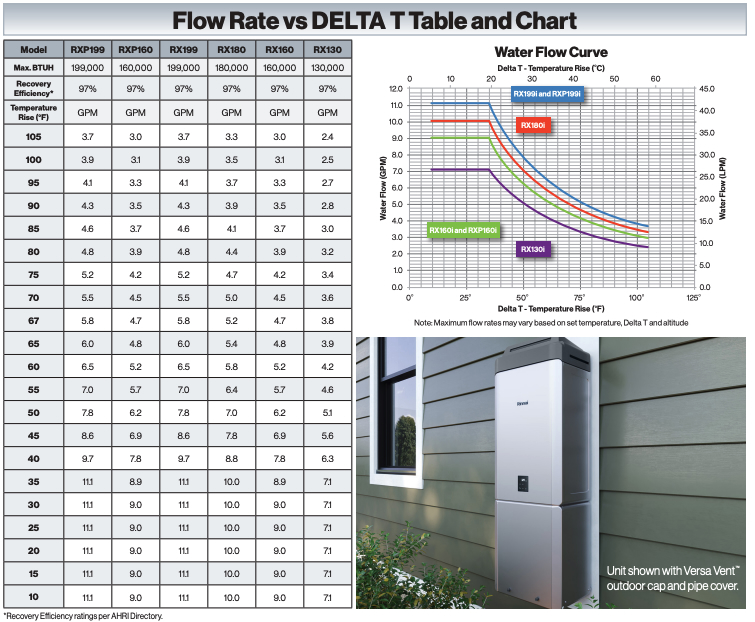
Use Delta T, or temperature rise, to determine available flow. Delta T is the difference between the desired hot-water setting and the coldest annual incoming groundwater temperature. For example, say 120º F is the desired hot-water temperature, and the homeowner’s groundwater at the coldest day of the year is 50º F: 120°F target temperature − 50°F groundwater = 70°F Delta T
Consult the unit’s specification guide to ensure its maximum flow rate will be sufficient for the home based on the Delta T, or if more than one unit may be required. For instance, at 70°F Delta T, the Rinnai RXP 199 provides 5.5 GPM (see page 6). If a tub at roughly 4 GPM and a shower at roughly 2 GPM run together, the household’s demand could exceed that 5.5-GPM capacity, so two units would be recommended. If a home’s peak simultaneous demand exceeds what one unit can deliver, two SENSEI RX units can link via an EZConnect cable to function as a single, higher-capacity source—no need to oversize or compromise.
Part 2: Savings
Helping homeowners understand energy and cost savings starts with a simple explanation of how tankless water heaters work. A tank-style heater reheats stored water around the clock, whether anyone’s home or not. One of the biggest advantages of a tankless water heater is its ability to match energy usage to actual demand. For example, if the hot water demand at a given moment requires only 20,000 BTUs, the unit can modulate and operate at that level. In contrast, a traditional tank-style water heater with a 40,000 BTU burner will typically fire at its full 40,000 BTUs whenever it operates, regardless of whether that much energy is needed. This ability to deliver only the amount of energy required at the time of use improves efficiency and is one of the key benefits of tankless technology. (Some customers may also qualify for state or utility rebates—worth a quick local check.)
But the savings don’t end there. It’s helpful to urge homeowners to consider the total cost of ownership, not just the utility bill. Tankless water heaters have lower operational costs and last much longer than tank water heaters, which can offset installation costs. With periodic maintenance, tankless water heaters can last for more than 20 years, whereas traditional tank units average 10–15 years. In other words, the cost of a tankless unit is more accurately compared against the cost of two or more tanks. And because tankless water heaters are only the size of a small suitcase, they offer better value per square footage, returning living or storage space to the home.
The biggest thing PROs can do in the field to prevent callbacks is educate the homeowner. Accurate sizing and honest savings math help guarantee customer satisfaction, reduced callbacks, and referrals. For questions or additional information, don’t hesitate to reach out to a Rinnai live agent.